
The Art of Asking Questions
Three Rules for Having Conversations with College Coaches


The Greek mathematician Archimedes is credited with saying, “Give me a lever and a place to stand and I can move the world.” And while I doubt very much that Archimedes was familiar with the recruiting process for women’s lacrosse (though he was, to his credit, the first to calculate pi and was also prone to running naked through the streets of Syracuse shouting “Eureka!”), we can nonetheless apply his precept to our sport.
Stated simply: If you want to move the world in recruiting terms, your lever is the set of questions you are prepared to ask college coaches with whom you are in conversation.
Whether you’re a 2027 heading into your senior year searching for a recruiting match, a 2028 approaching September 1st, or a 2029 or a 2030 eyeing up your recruiting arc, you will have to do more than impress a coaching staff with your on-field play in order to earn a place on that school’s roster. You will also have to make the case -- through written and oral communication -- that you are the type of person who is a good fit for their team culturally and that you have lots to add to the locker room, the weight room, the sideline, the bus and the pre-game meal table. You are more than your set of on-field skills and every coach knows that a great “culture kid” can be worth her weight in gold -- or drachmas, for those still thinking in Archimedean terms.
I have heard of truly well-crafted emails moving the hearts -- if not also the minds -- of Ivy League coaches; and I’ve heard of student-athletes who have been disqualified from a coach’s consideration based on how they comported themselves in the interview portion of a campus visit. So while we’re not here to tell you to spend as much time brushing up on your conversational skills as you do drilling your defensive footwork, you should know that your communication with college coaching staffs can move mountains if you’re prepared to do the work.

President Franklin Delano Roosevelt had three pithy rules for public speaking: “Be sincere. Be brief. Be seated.” So with a nod to FDR, here are our three rules for engaging in conversations with college coaches:
Be prepared.
Be strategic.
Be you.
1. Be prepared. Do these two things: begin a spreadsheet and procure a small, pocket-sized notebook. Prior to a scheduled conversation with a college coach -- whether in-person or over the phone -- do your research on the school, the team and the coaching staff. Not only should you know the basics about the institution (size of undergraduate student body, academic strengths, unique campus offerings, etc.), you should also know the team’s record from the past several years, whether they routinely make the post-season and even the history of the coaching staff. (It’s worth knowing if the coach you’re speaking with played her college lacrosse for the coach you met with the week before. That’s a noteworthy talking point and might lay the predicate for an interesting question!) Record all of your hard-won data in your spreadsheet.
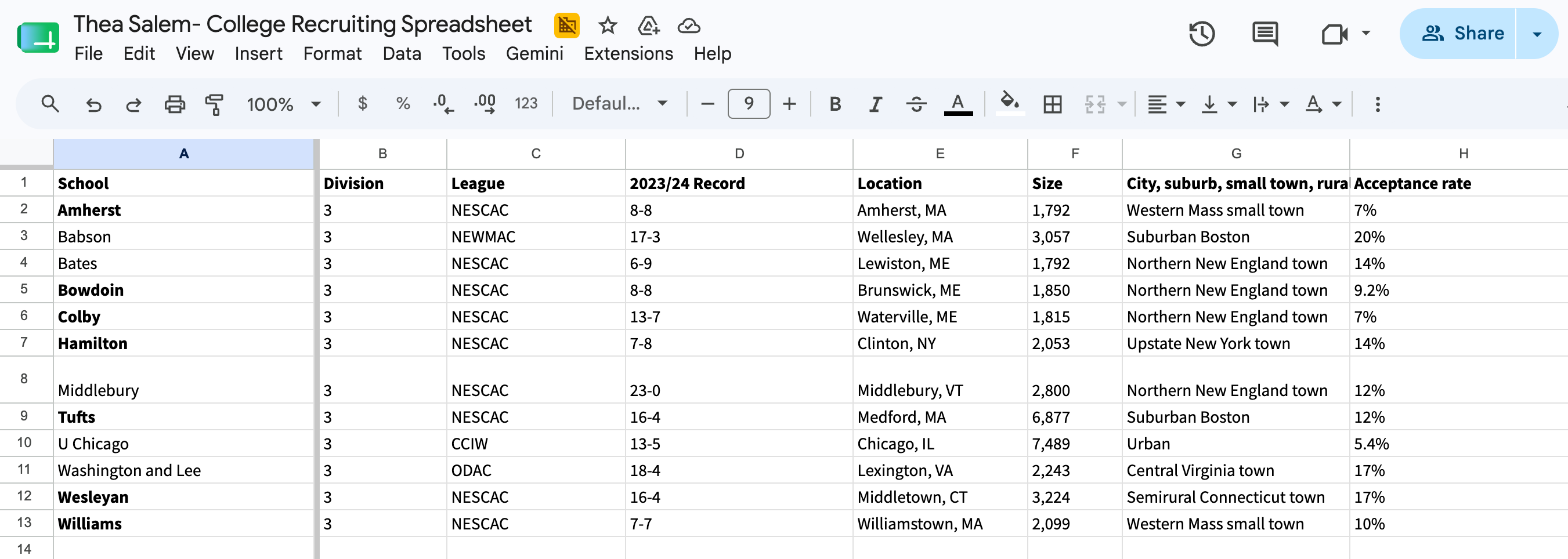
Thea’s spreadsheet had 20 columns and a row for every school in which she was interested. As she moved through the process, she bolded the schools that were rising to the top of her list and added columns to track her communication with coaching staffs. In addition to the columns visible above, she also had columns for: a school’s academic areas of excellence; head coach names, emails and cells; assistant coach names, emails and cells; dates of her outreach to schools; dates of their responses to her; dates of follow-up emails, calls and text messages; prospect/clinic dates; campus visit & call dates; and a miscellaneous catch-all column where she could record her subjective thoughts on each institution. Thea started the spreadsheet in the winter of 2025, at the very beginning of her recruiting journey, and added to it regularly. She closed it for the final time on the morning of July 1, 2026: the NESCAC contact date. My guess is that it was open in a tab in her browser for 18 months. I know it was in mine.
In addition to doing research on the school, team and coaching staff, take the time to anticipate the questions you’ll be asked and to prepare your responses. Every student-athlete heading into a conversation with a college coach should have at her fingertips answers to the following questions:
What are your strengths as a player?
What are your growing edges?
What are you looking for in a school and a college lacrosse program?
What will you contribute to our program?
Where are you in the recruiting process?
And, of course: do you have any questions?
Write down the above questions and your responses in your notebook. Write them anew -- even if you’re just jotting down shorthand versions -- prior to every sit-down or call with a coach. Think of it as a conversational warm-up, as routine as doing your heel sweeps and quad pull mobility exercises before a game.
When you field that last query from a coach -- Do you have any questions? -- you’ve reached the fulcrum point in the conversation. The coach has just turned the tables and it’s your turn to become the inquirer.
This is when you’ll want to reach for your list.
2. Be strategic. There is an art to asking a good question. With the rise of AI and a proliferation of large language models (LLMs), many folks think that the ability to fashion a good query is rapidly becoming an essential skill. The best questions accomplish three objectives: they extract useful information; they reveal something about the questioner herself; and they set the stage for the next question. Every question on your list should check those three boxes.
The student-athletes on my high school team know that I am a stickler for time. Chalk it up to being middle-aged or having been diagnosed with cancer at a young age or just to being a coach in a sport with a ticking clock. But I am a taskmaster when it comes to time. My time is valuable. So is yours. So is the time of the coach with whom you are in conversation. You will not have an infinite number of minutes to converse. Make the most of each one.
You should have six to eight questions prepared for each conversation with a coach. Write them in your notebook. Bring the notebook and a pen with you to the meeting or have it handy for your call. These are not crutches; they are tools. The student-athlete who has taken the time to prepare and consult her list of questions or who takes a few notes during the conversation is a kid who is diligent, earnest, interested and committed to the process.
Your six-pack of questions should push beyond the obvious. Do not, under any circumstances, ask a question that could be answered in a quick Google search or by browsing the school’s website. The coach will answer a question about available majors or the size of the undergraduate population politely and then she will make a careful mental note that at best you were under-prepared or, at worst, you don’t care and are mailing it in.
While versions of questions may repeat from school to school, you want to make sure that your set of questions telegraphs that you have an awareness of what makes that school and that program distinctive. You might, for instance, put at the end of your list a fun open-ended query like, “I’m curious about the last 30 seconds of your NCAA semifinal win. In the week leading up to the game, had you drilled that exact scenario: down by one without the ball with less than a minute on the clock?” Not only will that question open a window into the coach’s game prep and clock management philosophy, but it will also tell her that you’re paying attention to the sport at the next level, that you’re invested in her program’s success and that you’re curious about the work that goes into preparing a team for its biggest contests.
Finally, when thinking about your set of questions, give some strategic thought to the shape of the conversation. Ask your biggest, broadest questions first and leave your most specific questions for last. Be ready to skip a question if a coach inadvertently provides the answer to it in an earlier response. Or rearrange your list on the fly if that feels right. Read the flow of the exchange the same way you’d read the rotation of the defense in a player-up situation: permission to improvise. Ultimately, you’re in the driver’s seat steering an important dialogue in which both parties are trying to get to know one another in a relatively brief window of time.
3. Be you. Your list of questions is your fingerprint. It should be memorable and uniquely yours. Thea had six one-on-ones with college coaches. Six times she fielded that open-ended conversational pivot: do you have any questions for me? And at the end of those conversations, five of the six coaches remarked to her a variation of: “You asked such great questions! I haven’t been asked lots of those before.”
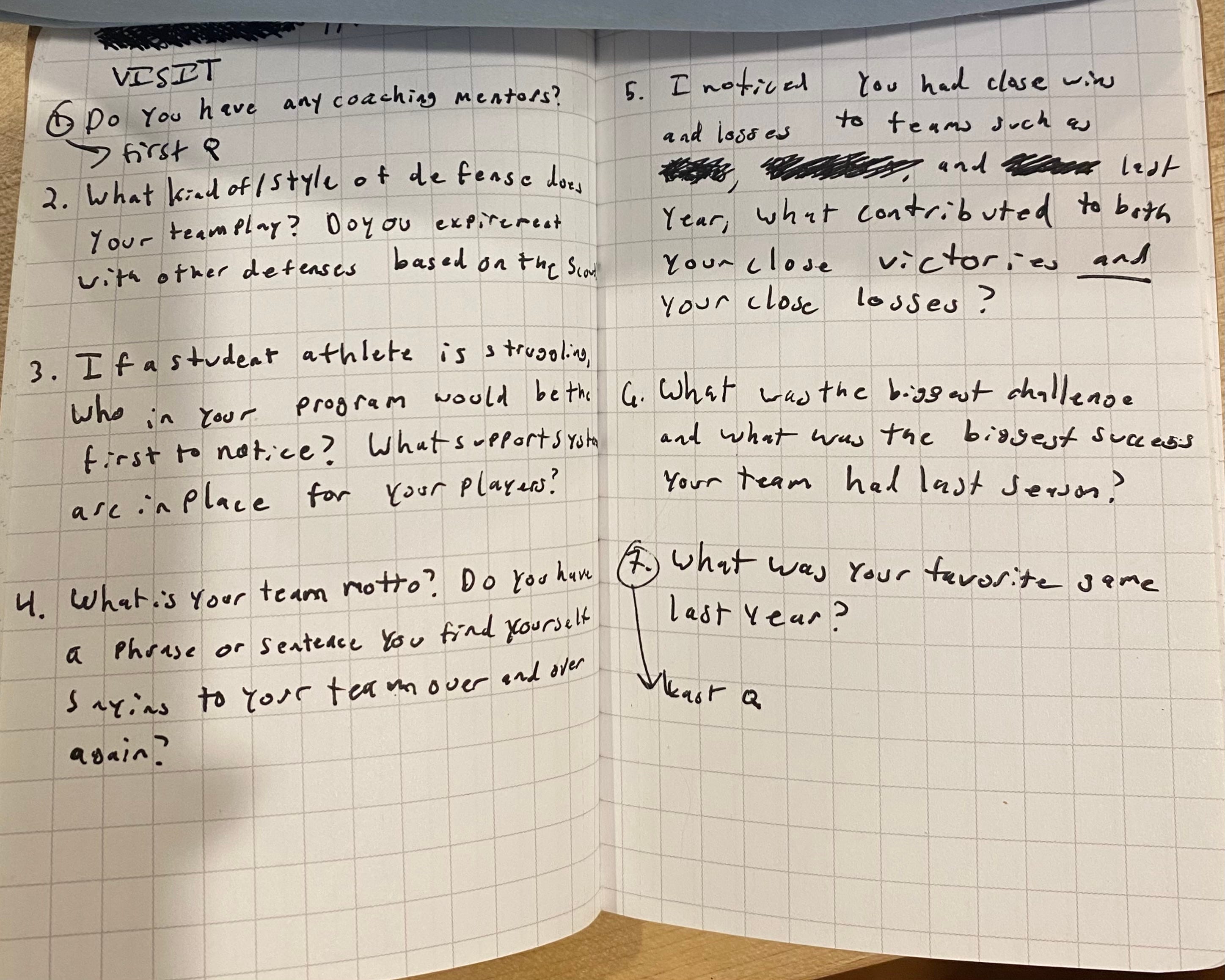
Thea is a culture kid -- she prizes hard work and she loves being surrounded by teammates who are as invested as she is in the process and the outcome -- so her lists of questions focused heavily on issues related to team culture, work ethic and accountability. She’s also a coach’s daughter, so she’s hard-wired to lift the hood on the best coaching minds in the biz to see what she can learn. What’s genuinely important to you? Whatever the answer is, make sure it’s evident in your list of questions.
The writer David Brooks was the first to delineate between résumé virtues and eulogy virtues. The former are the line items you might post on LinkedIn or include at the top of your IWLCA Sports Recruit profile: team captain, All-League, team leader in CTOs, etc.. The latter are the attributes others credit you with having: kindness, a strong work ethic, an inextinguishable desire to compete, an unerring sense of team. The eulogy virtues are not easily quantifiable; they don’t show up on a stat sheet. But they do show up in conversation: in your body language and composure; in your responses to a coach’s questions; and in the subtext of the questions you pose in return. Let your questions -- and not just your answers -- tell the story of who you are.
In the name of transparency, here are a few basic questions that Thea used as jumping off points to make her bespoke list for each of her six coaches’ conversations:
Who on your team would you say is responsible for generating accountability? Does it come from the coaching staff? From the captains? From the team in its entirety?
What are three words your seniors would use to describe your team culture?
If a student-athlete is struggling for any reason -- injury, homesickness, academic pressure, etc. -- who in your organization would be the first to notice and what remedies are available to help that person?
Do you have a coaching mantra or does your team have a phrase or a saying that captures who you are and what you’re about?
Who are your coaching mentors?
What’s been the biggest challenge your program has faced in the last three seasons?
What was your favorite game this past season?
So there are some step-by-step instructions on how to fashion your lever. And Thea and I will be here, holding this space as a place where you can plant your feet and stand. Now go on and move the world.
And as Archimedes would say: “Eureka!”
Happy recruiting!
Amory & Thea
***